

Yogis ahead of science: Which nostril is running the show?


Let’s conduct a quick experiment. Place your index finger over the left side of your nose and press down, blocking your left nostril. Slowly inhale and exhale through your right nostril and notice whether it’s easy or challenging. Then do the same on the other side. Which nostril is easier to breathe through right now?
If it’s your right nostril, the Shiva Svarodaya says this is the time for performing accurate and hard work, writing, learning and practicing the use of arms and weapons, eating, sex for men, enchanting women, attracting others, studying and teaching difficult branches of knowledge, climbing mountains and forts, risky and heroic feats, physical exercise and so on.
If your left nostril is more open, the text recommends charity, making treaties and agreements, practicing yoga, treating difficult illnesses, mental and creative work, sweet and friendly activities, making friends, sex for women, auspicious deeds, teaching, peaceful and developmental work and so on. (1)
Which sounds more appealing to you right now?
What yogis knew
Yogis paid very close attention to the flow of air through the nostrils and discovered that at any given moment, one nostril is more open than the other, and the dominant side changes over the course of the day.
They built a whole system around this observation. Svara yoga, the tradition behind the Shiva Svarodaya, matches daily activities to whichever nostril is more open. Hatha yoga explains the pattern through two energy channels, or nadis. Pingala, the solar channel, ends at the right nostril and is heating and energizing. Ida, the lunar channel, ends at the left and is cooling and calming. When the two are balanced, prana can enter sushumna, the central channel, and the mind becomes steady.
Yogis also learned to shift that balance on purpose. Surya bhedana, inhaling through the right nostril and exhaling through the left, was used to warm and energize the body. Chandra bhedana calls for breathing in through the left nostril and breathing out through the right to cool and settle the system.
When science caught up
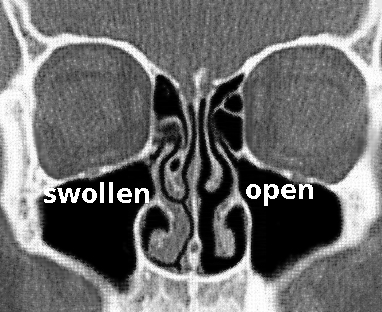
Western medicine eventually came to the same observation. In 1895, the German physician Richard Kayser noticed that nasal congestion alternates between the right and left sides. We now call this the nasal cycle.
The mechanism turned out to involve erectile tissue lining the inside of the nose. On one side, blood vessels constrict, the tissue shrinks and air flows freely. On the other side, the tissue fills and the nostril closes down. The switch is controlled by the autonomic nervous system, the part of us that shifts between activation and rest without our conscious input.
Researchers then began testing what yogis had been doing for centuries. For example, in a 2008 study, experienced practitioners spent 30 minutes breathing only through the right or only through the left nostril. Right-nostril breathing raised their blood pressure, and left-nostril breathing lowered it. (2)
The scientific method seems to confirm the yogic findings, and it’s easy to test for ourselves, as we did at the beginning of this post. In Patanjali’s terms, that experiment gives us the first proof, direct experience, and the texts and research together give us the third, authoritative testimony.
Additional layers
The yogic tradition takes it further. According to the yogic system of ida, pingala and sushumna, energy can build up or run low in the left or right channel, throwing the whole system out of balance. This imbalance can have long-lasting effects. When the lunar channel is out of balance, it can lead to insecurity, instability, depression and disillusionment. When the solar channel is out of balance, it can lead to anger, arrogance, impatience and fanaticism. Either way, the flow of energy is obstructed and prana cannot enter sushumna. The purpose of yoga practice, then, is to remove the blockages and bring the system back into balance. We can do that by practicing techniques like chandra bhedana or surya bhedana to work with the individual channels, and nadi shodhana and pratiloma ujjayi to balance them.
We don’t know of any studies that link excess right-nostril breathing with anger, for example. Inference, Patanjali’s second proof, can fill part of the gap. If we think of excessive right-nostril dominance as a sign of chronic sympathetic overactivation, we can plausibly see how it could lead to hyperarousal states like anger and impatience.
Try it for yourself
Next time you’re feeling a bit testy, try to sedate your right channel by practicing chandra bhedana, inhaling through the left nostril and exhaling through the right. (According to the yogic tradition, breathing in through a nostril activates it, and breathing out through it sedates it.) Check out the video of this technique below, there are some nuances there. And if you find yourself feeling lethargic or uncertain, try surya bhedana, which means inhaling through the right nostril and exhaling through the left.

How does it make you feel?
Next time, we’ll follow the breath deeper, to the vagus nerve. Tune in!
References
(1) Satyananda Saraswati, S. (1999). Swara Yoga. Nesma Books India, p. 176. Activity lists as summarized in “Shiva Swarodaya,” Wikipedia.
(2) Raghuraj, P., & Telles, S. (2008). Immediate effect of specific nostril manipulating yoga breathing practices on autonomic and respiratory variables. Applied Psychophysiology and Biofeedback, 33(2), 65–75.