

Yogis before science: How yoga became a biophilic practice long before we had the word

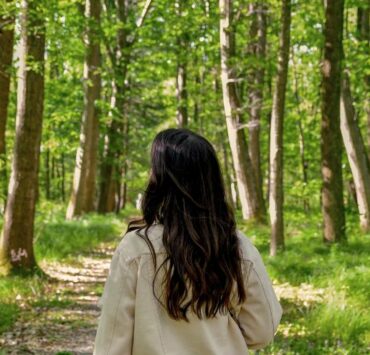
Last week, we discussed Attention Restoration Theory, an explanation of why a walk in the woods helps clear the mind. This phenomenon is called soft fascination, which allows the depleted part of the mind to rest and recharge by effortlessly noticing the shifting and movement of light, air, trees, and wildlife. But attention restoration is only one piece of a much larger puzzle.
The bigger idea
In 1984, the biologist E. O. Wilson gave the whole puzzle a name. He called it biophilia — “the innate tendency to focus on life and lifelike processes.”
His argument was that humans are not neutral about the natural world. We are drawn to it, wired for it, dependent on it in ways we barely notice. Our nervous systems developed inside forests and grasslands, next to rivers and animals and other people. When we are near living things, our whole physiology responds as if it has come home.
The research since then has gradually filled in the picture. In 1984, the environmental psychologist Roger Ulrich looked at recovery records from a Pennsylvania hospital. Patients who happened to be assigned to rooms with a window facing trees had shorter hospital stays and needed fewer strong pain medications than patients in rooms facing a brick wall.
The Japanese practice of shinrin-yoku — forest bathing — has produced a body of research showing that time spent among trees significantly lowers cortisol, the body’s main stress hormone. A 2019 study at the University of Michigan found that as little as twenty minutes in nature was enough to lower cortisol measurably, with effects lasting well beyond the walk itself.
Our nervous systems know what the intellectual mind might have forgotten: we are not separate from the natural world, and we feel best when we are inside it or it is reflected in our living environment.
Yogis have known this all along
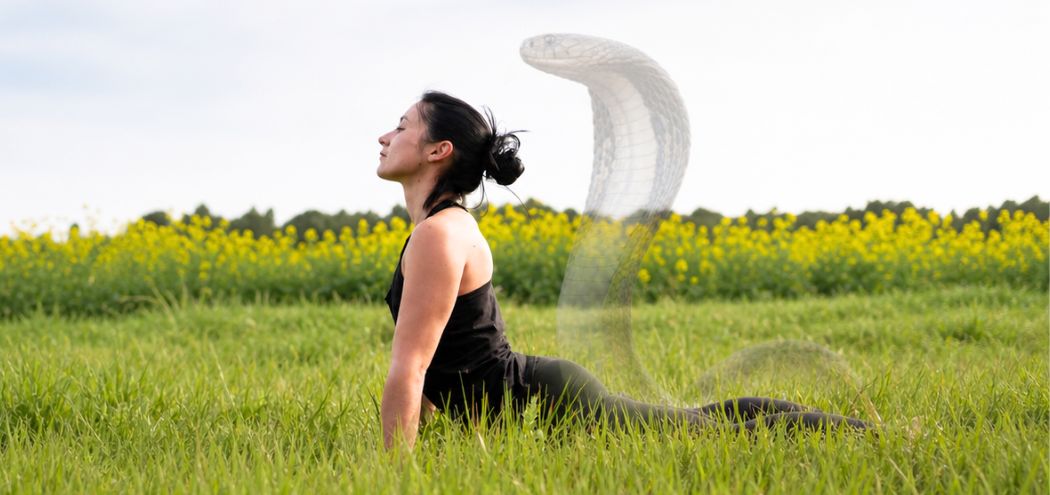
Here is what is interesting for those of us who practice yoga. If you look at the names of yoga postures, some things begin to become obvious. Does this sound familiar? Tree. Mountain. Cobra. Cat. Cow. Fish. Eagle. Warrior. Camel. Dolphin. Lotus. Locust. Downward-facing dog. Frog. Crow. Pigeon. Swan. Moon. Sun.
Yoga is, at its root, a practice of embodying nature. Not thinking about nature. Not sitting near it. During a yoga practice, we are actually shaping the body into the forms of trees, animals, mountains, and waves. The shapes we assume and the qualities they represent remind our nervous systems where we belong. And this unconscious awareness is incredibly comforting to the nervous system and can have the same effects mentioned above: lower cortisol, deeper breathing, attention restoration, and overall parasympathetic response, which moves us into the rest-and-digest mode.

The sun salutation is not just a warm-up sequence. It is a small conversation between the body and the sun. The tree pose is not a balance drill; it is a felt experience of what it is to be rooted in one place while reaching upward. The cobra is not just a backbend; it is an undulation of a snake that feels the vibrations of the ground through its belly.
Yoga was a biophilic practice for thousands of years before anyone thought to give the idea a name.
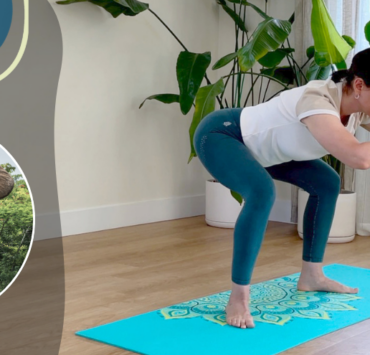
During the past few weeks, when we moved like gorillas in the fire practice, we were not just borrowing a stress-relief technique. We were touching an older piece of wisdom that the human body’s physical expressions are similar to those of other animals. When we undulated through the swan practice, we were referencing the wave a swan glides on. We were not imitating nature from a distance; we were finding it within ourselves.
The next two practices in this series will continue the same conversation. When you root down like an elephant or lift like an eagle, think of yourself as embodying the wisdom of nature. It happens every time we assume organic shapes or animal forms, and it has a profound effect on the health and resilience of our nervous system.
References
- Edward O. Wilson, Biophilia (Harvard University Press, 1984)
- Roger S. Ulrich, “View through a window may influence recovery from surgery,” Science (1984)
- Qing Li, Forest Bathing: The Japanese Art and Science of Shinrin-Yoku (2018)
- MaryCarol R. Hunter et al., “Urban nature experiences reduce stress in the context of daily life,” Frontiers in Psychology (2019)