
Yogis ahead of science: The humming bee and the wandering nerve

Sri Krishnamacharya used to say that if you can breathe, you can do yoga. Breath is at the heart of every practice. Yogis spent centuries observing the effects of different ways of breathing and developed pranayama, a set of techniques for expanding prana, the life force. Pranayama is a sophisticated system for influencing our energy and physiology. Western science began to see the link between specific breathing patterns and physiological regulation much later, when scientists traced it to the vagus nerve.
What yogis knew
Yogis understood that the exhale settles our systems. In the yogic science of ratio, lengthening the exhale is a calming, reducing (langhana) practice, and lengthening the inhale is a building, energizing (brahmana) one. A teacher could change a student’s state by changing the proportion of the breath.
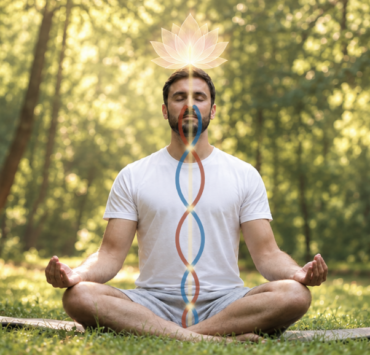
Yogis also worked with vibration. In ujjayi, the ocean-sounding breath, we slightly narrow the passage at the back of the throat, which creates a subtle vibration and makes each breath longer and smoother. Bhramari uses a humming sound on the exhale. According to the Hatha Yoga Pradipika, the reward of this practice is bliss arising in the mind.
The long exhale, the vibration in the throat and the hum are three different tools for regulating our physiological state and calming the mind. How do they work?
What science discovered
In 1847, the German physiologist Carl Ludwig noticed that heart rate rises on the inhale and falls on the exhale. We now call this respiratory sinus arrhythmia, and it’s driven by the vagus nerve.
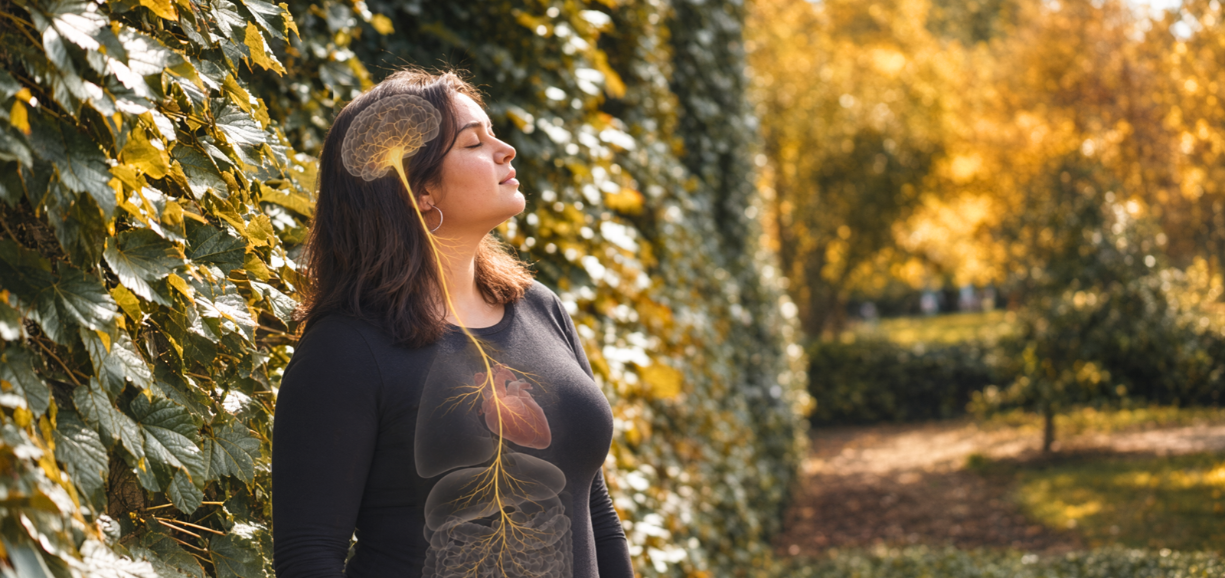
The vagus nerve is the longest cranial nerve in the body. Its name comes from the Latin for “wandering.” It starts in the brainstem and passes through the throat to the heart, the lungs and most of the digestive tract. It carries most of the signals of the parasympathetic nervous system, the “rest and digest” branch. About 80% of its fibers carry information from the body up to the brain. In other words, it continually tells the brain whether we’re safe.
The vagus nerve acts like a brake on the heart. On the inhale, the brake eases off and the heart speeds up a little. On the exhale, the brake comes back on and the heart slows. A longer exhale keeps the brake on longer, which is why it calms us down. The nerve’s branches also run the muscles of the larynx, the part of the throat we use for ujjayi and for humming.
The latest research
In a 2011 pilot study, researchers scanned the brains of 12 people as they chanted OM. The chanting quieted activity in the amygdala and other parts of the brain’s emotional centers. The authors noted that the pattern resembled what is seen with electrical vagus nerve stimulation, a treatment used for depression and epilepsy. (1)
A 2024 review gathered 46 studies on bhramari. Across them, the practice lowered blood pressure and heart rate, improved heart rate variability (a common measure of vagal activity) and reduced anxiety, sometimes after a single session of five minutes. (2) The review also shows how young this research is, though. Most studies were small, most were done in India, and only six were randomized controlled trials. The yogic texts are confident, and the science is promising and still catching up.
Try it for yourself
Bhramari and humming in general is a good practice for evenings, for moments of anxiety, or whenever the mind won’t stop spinning. In this short humming practice, we begin lying on our back and humming on each exhale, letting the vibration spread through the chest and throat. Then we rest and breathe deeply. We come up to sitting for a second round of humming, and finish by breathing normally and noticing the sensations that follow.

This is a very simple practice with no movement other than changing body position. Notice how you feel after several rounds of humming. That’s your first proof, your direct experience. Since the vagus nerve links breath, throat and heart, it makes sense that practices working on all three would shift our state. This is inference, the second proof. For testimony, yogic texts and the modern research all point the same way.
Next time, we’ll move from the body to the mind, and to Patanjali’s own instruction for handling difficult thoughts. Tune in!
References
(1) Kalyani, B. G., Venkatasubramanian, G., Arasappa, R., et al. (2011). Neurohemodynamic correlates of “OM” chanting: A pilot functional magnetic resonance imaging study. International Journal of Yoga, 4(1), 3–6.
(2) Chetry, D., Chhetri, A., Rajak, D. K., Rathore, V., & Gupta, A. (2024). Exploring the health benefits of bhramari pranayama (humming bee breathing): A comprehensive literature review. Indian Journal of Physiology and Pharmacology, 68(1), 71–85.