
When you can’t control the world: Manageability and the size of your Zorro Circle

There is a quiet trap many of us fall into: we treat worry as proof of love. We fret about the people we love, the problems we want to solve, the state of the world — and somewhere underneath, we believe that all this fretting means something. That to stop worrying would be to stop caring. But fretting is not caring; they can even work against each other. The more we fret about what we cannot control, the less energy we have left for what we can. So how do we care about a difficult world without fretting ourselves into exhaustion?
This is the heart of the second pillar in Antonovsky’s framework on dealing with stress. So far in this series we have looked at the mounting toll of living in an uncertain world, and at the first pillar of staying well: comprehensibility, the sense that what is happening can be understood. This week we turn to the second pillar, manageability, which is a sense that we have what we need to cope with life’s challenges. And manageability begins with the difference between fretting and caring.
The feeling of everything being out of our hands
There is a specific kind of helplessness that comes from caring about things we cannot control. We read the news and feel the weight of enormous political, economic, or environmental problems. We want someone to do something about it, we want to help, and we run straight into the wall of our own smallness. What can one person actually do about any of it? Left unchecked, that feeling of helplessness can spread into other areas of life, until even the things we can affect start to feel pointless. We become convinced that we have no power at all.
Psychology has a name for the dynamic that governs this feeling, and it turns out to be one of the most useful concepts for understanding manageability.
Locus of control
In 1954, a psychologist named Julian Rotter introduced an idea he called locus of control — essentially, where a person locates the source of what happens to them.
People with an internal locus of control believe that most of their life outcomes are the direct result of their own efforts. I make things happen. Look what I can do. I determine my future. They tend to feel that their actions matter.
People with an external locus of control believe that most of their life outcomes are outside their control and are governed by luck, fate, powerful others, or circumstance. Why bother. There is nothing I can do. Why does this always happen to me? At its furthest extreme, an external locus becomes learned helplessness; a refusal to take action to improve one’s circumstances at all.
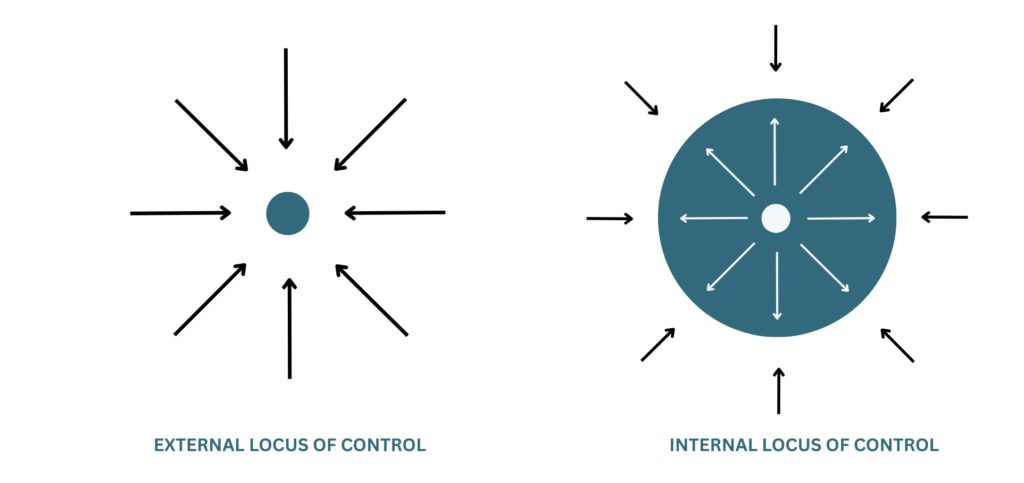
The research here is fairly consistent: those who have more internal, rather than more external, locus of control usually do better. People who feel they can influence their lives tend to take better care of themselves, recover better, and cope more effectively with stress. Yet our current moment of relentless, large-scale crises keeps shrinking this internal locus of control, making us feel that there are fewer and fewer things we can actually affect. As a result, the fretting goes up; the sense of personal agency goes down.
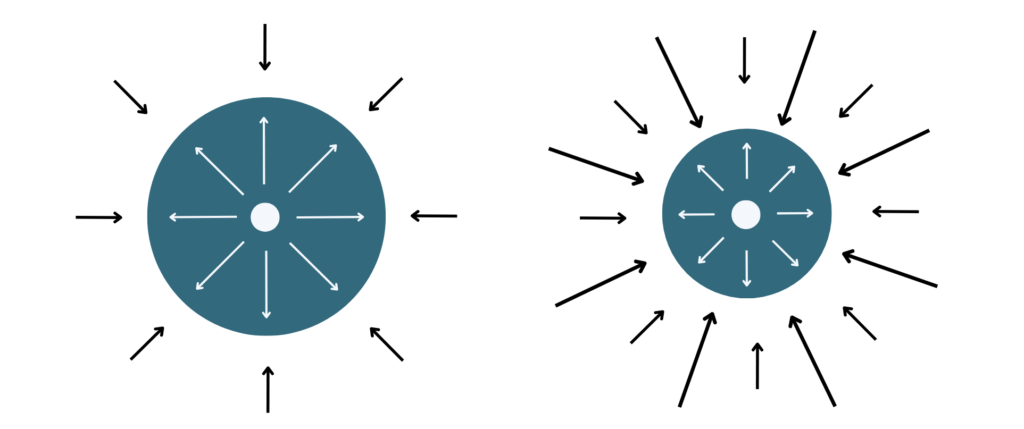
Shrinking of the internal locus of control under external pressure
So how do we prevent our circle of influence from shrinking and resist the sense of doom that makes us feel helpless?
The answer is not to pretend we can control more than we can; it is to get clear, and honest, about what is actually in our hands. And there is a wonderful old story that shows how.
The Zorro Circle
In the legend of Zorro, a young, passionate, undisciplined man named Alejandro wants to fight every villain and right every injustice in the world — all at once. He fails spectacularly, over and over, until he is left feeling disillusioned and powerless.
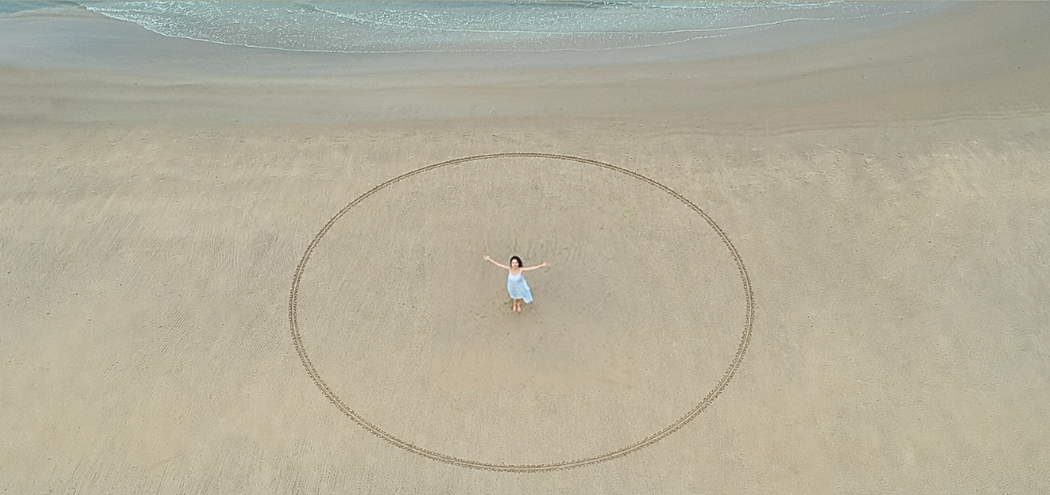
Then an aging sword master named Don Diego takes him on. To begin the training, Don Diego draws a circle in the dirt and allows Alejandro to fight only within that circle. Nothing outside it. Only once he has truly mastered that small space is he allowed to expand it a little, and then a little more. Before long Alejandro is swinging from chandeliers and winning every duel. But none of it would have been possible without first mastering that one small original circle.
The author Shawn Achor uses this story to describe how we build a sense of control. First, we limit the scope of our efforts, then we watch those efforts have an intended effect. In the process, we accumulate the resources, knowledge, and confidence to expand the circle, gradually conquering a larger and larger area.
This is practical manageability. We do not rebuild a sense of agency by trying to fix the whole world. We do it by drawing a circle of the right size for our current level of energy and other available resources (time, money, mental space, etc.). It has to be small enough so that we can actually master what is inside it. Each small success becomes real evidence that our actions make a difference. And that evidence is what allows us to gradually expand our Zorro Circle.
How to find your circle
The practice is simple, and you can do it on paper in a few minutes.

Pick an area of your life where you feel stuck or overwhelmed right now. It might be your health, your work, a relationship, or some other specific issue. Draw a small circle and write the problem in the middle of it. Then draw a larger circle around it — this is your Zorro Circle, your circle of control.
Inside the circle, write the things you genuinely can influence in this situation. Outside it, write the things you cannot. Be honest about both. The point is not to pretend you have more control than you do, and it is not to give away control you actually have. It is to see clearly where the line falls. Then look at it and reflect on how you can improve the things that are in your control — how can you master your Zorro Circle? What steps can you take?
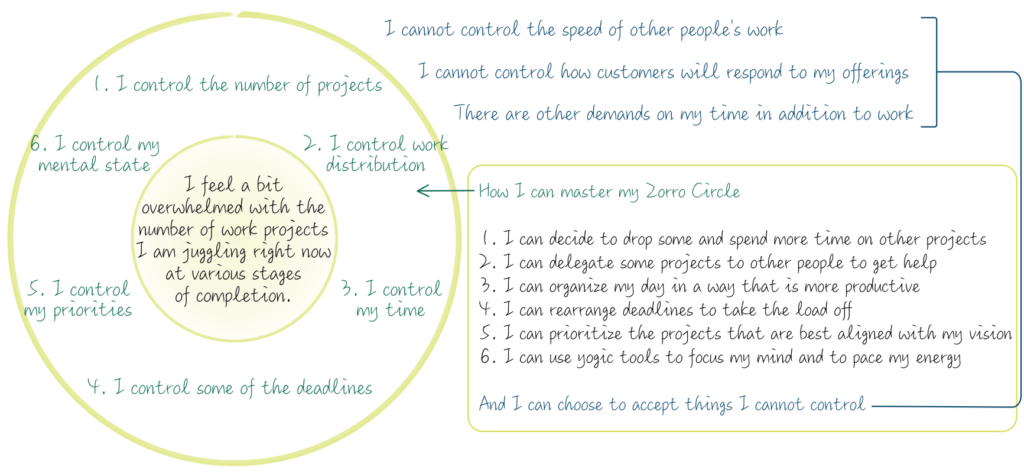
Example of a simple Zorro Circle
That is where manageability begins. We cannot control the storm, but we can tend skillfully and deliberately to our own Zorro Circle.
Your yoga mat is another Zorro Circle. Every time we step onto the mat, we enter that circle and practice caring for ourselves by working with our breath, our attention, the next movement, the way we meet a difficult sensation. Everything else, including fretting, stays outside of it for a time. This way, we can practice the skill of manageability by working faithfully within the bounds of what we can actually affect.
And the more we practice caring without fretting — on the mat, on paper, in the small circle of an ordinary day — the more we grow our sense of empowerment.

In the next post, we look at the third pillar of the Sense of Coherence: meaningfulness, the sense that life is worth engaging with at all.
References
- Aaron Antonovsky, Health, Stress and Coping (1979)
- Aaron Antonovsky, Unraveling the Mystery of Health (1987)
- Julian B. Rotter, “Generalized expectancies for internal versus external control of reinforcement” (1966)
- Shawn Achor, The Happiness Advantage (2010)



It’s a revelation to see my yoga mat as a Zorro circle. I think I will never forget the concept, for it relates to all aspects of me, my life, and my being. Thank you
Thanks, Olga! How relevant for our times. Both the external events of our times and the information overload can throw me off my stable center. This refocusing and refining process is so wise.