
Where does meaning come from? The seven wells inside us


My mother was the greatest optimist I have ever known. She could find meaning in all kinds of places: events, conversations, chance encounters, major societal changes. Things happen for a reason, she would say, as if pulling on any thread of her life seemed to reveal a pattern. When I was around her, I felt like I was included in the practice of looking for the meaning in all things.
And then she died of cancer at fifty-five.
That did not make sense. There was no hidden meaning in that, just a too-early death, arbitrary and final. It took the wind out of my sails and squashed the whole things happen for a reason idea. I had to process that disorientation and gradually rebuild my own sense of meaning. And it made me wonder, where does the sense of meaning come from? How do we rebuild it when it’s lost?
The most important pillar
In the framework we have been working with through this series, Antonovsky named three things that allow a person to stay well in a difficult world: comprehensibility (the sense that what is happening can be understood), manageability (the felt confidence that we have what we need to cope), and meaningfulness (the sense that life is worth engaging with at all). He considered the third the most important. Understanding a difficult life and coping with it skillfully are not enough on their own. There has to be something that makes the effort feel worth it.
Meaning is the most personal of the three pillars, and the hardest to articulate. It can come from a sense of purpose — a clear why that orients a life. It can also come from quieter places, less obvious, that we don’t always know how to name. The yogic tradition has been pointing, for a long time, at all the places it lives within us. There is not one source of meaning, but many. And when one runs dry, others remain.
Seven places meaning lives
The yogic tradition maps human experience onto seven main centers, traditionally called chakras. Chakras are portrayed as energy hubs located along the central axis of the body, each one associated with a different level of human experience. Each chakra is an energy center, and it is also a kind of well — a place we can draw vitality from. And each one is also a place where meaning can be found, if we know to look there.
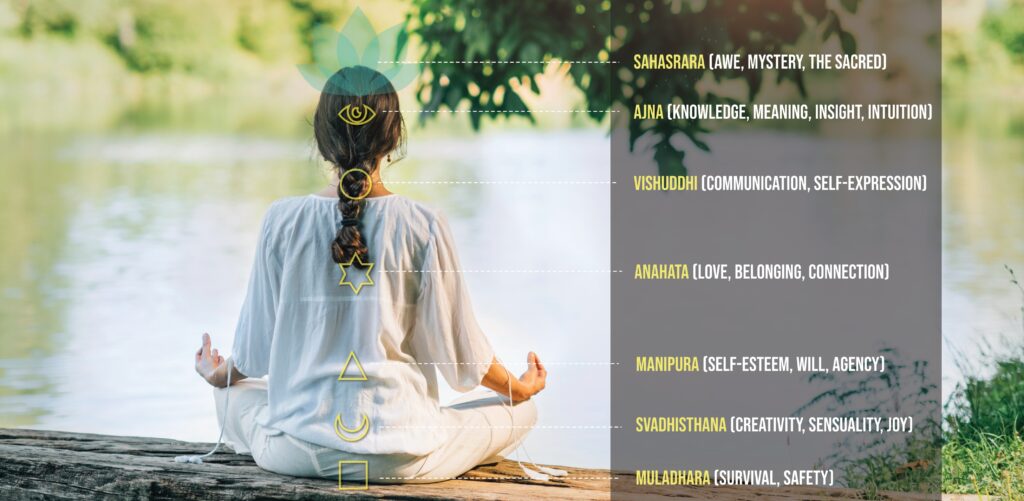
The root — Muladhara — at the base of the spine. It is the level of safety, ground, body, home. I exist. I am here. I have a place on this earth. The meaning here is not abstract; it is the meaning of simply being alive in a body in this moment. The morning cup of coffee. The familiar floorboards underfoot. The fact of waking up at all. People who have lived through war or serious illness often come back speaking of this level: the sheer meaningfulness of still being here.
The sacral center — Svadhisthana — in the pelvis. It is the level of pleasure, creativity, sensuality, the joy of being alive in a body. I feel. I create. There is delight to be had. Cooking something good. Touching another person. Making something with your hands. Music, dancing, the small daily pleasures that have no purpose beyond themselves. The meaning here is the meaning of being creative and experiencing the world in all its richness, through the body.
The navel center — Manipura — at the solar plexus. It is the seat of inner fire and will. I act. I make things happen. This is where personal agency lives, and ability to make choices and follow through. The meaning here is the meaning of doing — of having an effect, of acting on the world, of feeling our own strength.
The heart — Anahata — in the chest. It is the level of love, connection, compassion, belonging. I love. I am loved. I am linked to others. The meaning here is the meaning of being in relationship — with people, with animals, with places, with the dead. For many of us, this is the most reliable well of all. Even when nothing else makes sense, love still does.
The throat — Vishuddhi — at the base of the neck. It is the level of voice, truth, expression. I speak my truth. I am heard. The meaning here is the meaning of being able to say what is true, to put words to what we know, to express what we have lived. When we feel lost, speaking to a friend, in a journal, or through a piece of writing can re-animate and invigorate us.
The third eye — Ajna — between the brows. It is the level of insight, perception, seeing clearly. I understand. I see what is happening. The meaning here is the meaning of comprehension itself; of making sense of one’s life, of seeing the patterns that are there, even when other patterns have scrambled. This is also the level of intuition, when we sense invisible patterns.
The crown — Sahasrara — at the top of the head. It is the level of connection to something larger than the self. I am part of something significant and vast. This is the meaning of spiritual experience, of awe, of mystery. It is the meaning that comes from belonging to nature, history, a tradition, a community, a sense of the sacred, however one defines it.
All seven at the same time
What I find most useful about this map is that all seven of these are alive in us at the same time. They are simultaneous, parallel sources of meaning, all of them available, all of them part of what it is to be a whole human being.
In the moment we are living through, certain sources of meaning are under particular pressure. The crown level (the sense of being part of a coherent larger story) has been badly shaken for many of us. So has the third eye level — the feeling that the world makes sense, that we can see what is happening. And for many, the throat level too — the sense that what we say can be heard and can matter.
But the body still has other wells. The root chakra is still there: you are alive, in a body, on the earth. The sacral chakra is still there: there is still beauty, food, music, touch. The heart is still there: there are still people you love and who love you. Even the throat chakra can still be drawn from: you can still express yourself and speak what is true.

This is one of the most underappreciated things about resilience: the people who come through hard times intact are usually not the ones with the strongest purpose, but the ones who can draw from multiple wells of meaning. This is also why some sources of meaning are so reliable. Service, for instance — caring for others, contributing, giving what we have — draws on multiple wells at once. The love of the heart, the agency of the navel, the expression of the throat, the belonging of the crown. Service is not one well; it is what flows outward when we draw from several at the same time. That is part of why it sustains people through hard times when single-source meanings have dried up.
The body knows
The thing I love most about the chakra map, after all these years of working with it, is that it is not an abstract philosophical idea. It is a representation of what already lives in the body. Anyone who has done an intentional yoga practice has felt them: in the moment when the chest expands and the heart fills in a backbend, when a mantra releases something that was held back, when anchoring through your feet finally unloads whatever was weighing you down. And the breath, it truly is the key to so many inner locks.
An integrated yoga practice is a small daily reminder of all the wells that nourish us. It’s the body’s way of saying: Come back and drink.
This is what yoga does that is hard to explain to someone who has not done it. It is not relaxation, exactly. It is not stretching, exactly. It is the slow, regular practice of touching every level of one’s own being, and remembering that meaning lives in all of them.
Where this leaves us
Antonovsky was right that meaningfulness is the most important of the three pillars. But he did not say where meaning comes from. He left that question open, and the yogic tradition gives us its own answer. Meaning does not come from one source; it comes from seven, and they are all available, all the time, in the body we already have. When one of them dries up, the others still remain. The work, then, is not to find a new purpose. It is to remember the wells we have stopped dipping into.
Next week, we will bring the three pillars together (comprehensibility, manageability, and meaningfulness) and look at how they hold one another up — tune in!

In the next post, we bring the three pillars together (comprehensibility, manageability, and meaningfulness) and look at how they hold one another up.