
Words matter: Yoga cues to help with anxiety



When people think of the aspects of a great yoga teacher, they often conjure up the image of a soothing, peaceful voice and someone saying all the right things. And great classes can be like that. The teacher seems to say the exact thing you need to hear at that moment. No more, no less. The yoga itself helps to calm us down, but the demeanor, energy and voice of the guide are essential factors as well. But it’s not just how the yoga teacher speaks; it’s what they choose to say.
There are some well-intentioned cues that are repeated again and again in yoga classes that can potentially do the opposite of the aim – especially when it comes to cues about breathing. This is extremely important for helping folks experiencing anxiety. Since we know that with anxiety, there’s a change to breathing, breath can also be a significant factor in helping to relieve anxiety.
Let’s look at some of the ways we can improve talking about the breath in a yoga class:
Are you breathing?
This is something I learned in a Franklin Method Training: we did an experiment where we, as teachers, didn’t breathe well (we just kept inhaling and barely exhaled) but practiced teaching a partner and kept saying the word “breathe” or “make sure you breathe.” Even though our words were well-intentioned, the effect was quite stressful for our partners. Breathing is one of the ways we humans mirror each other. If you as a teacher are not breathing well, your class won’t be either. Instead of just using your cues, take a moment to make sure you’re exhaling if you notice this happening. Ground yourself. Slow down your own words.
Tone and tempo – the music of the words
How we say what we say is important. Explore the change of tone in your voice when teaching. If you say the word “exhale” while descending in tone, it can have a significant effect. More importantly, you can explore the change of tone without putting on an artificial voice. Try it out in your own natural voice. If you teach a flow/vinyasa style and cue when to breathe, this is also a place where we can make sure to help our students deal with anxiety. I used to simply say, “Follow your own breath. If you’re ahead or behind my words, that’s okay. Stay with your pace.” But I’ve found that it’s not a setup for success for everyone even then. I’ve had several students share that it’s very stressful to think they’re not “doing it right” unless they’re matching breath and movement. For many, especially folks new to yoga, breathing-compromised or dealing with anxiety, it’s a source of frustration and confusion to feel “off” with the breath.
I’ve been toying with the idea of introducing a flow without the breath at first. For example, a sort of half Sun Salutation with arms reaching up to the sky followed by a side bend to each side, followed by Uttanasana (Standing forward bend). Once folks have the flow, I say something like, “maybe you’re inhaling when your arms come up and exhaling into the side bend…or maybe you’re breathing at a different pace than you move. You might try both.”
If you do teach a fast-paced style and cue something like “Inhale, Urdhva Hastasana, exhale Uttanasana,” make sure to read your group. See that you’re giving enough time and not too much time for folks to stay with it. Otherwise, not only will people be gasping, which makes anxiety much worse, they could also be feeling they’re failing.
What we say
This brings me to what we can say to bring about a better breath. Using phrases like “deep breath” can lead to more emphasis on inhaling and again, although it’s well-intentioned, it can actually make anxiety symptoms worse. What’s needed is an emphasis on the exhale. Possibly instead of “deep,” using phrases like “elongated exhale,” or “complete breath out,” or even “full and soft exhale” can bring more color to the class as well as help shift some of the symptoms that come from anxiety. If we can make any focus on breathing an invitation rather than a command, that’s also helpful. Beginning phrases with a question like “can you feel the breath in your toes?” can allow space and exploration rather than a definite action.
Making sound can also help with the breath. It slows down the breathing, which helps to strengthen the diaphragm. It might be a lot to do over and over in a yoga class, but here and there, inviting sound, “shhh” on the exhale or pretending to slowly blow out a candle through “oooh” shaped lips can help with down-regulating the nervous system and calming anxiety.
How much we say
We can see how what we say matters and how much of what we say can make a difference for our students. Taking a class where the teacher is listing off all the to-do lists in a pose can feel overwhelming for anyone, not to mention someone who is already feeling overwhelmed because of anxiety. Explore simplicity. You can do this within one pose, as though just offering one point of focus. Repeat one simple cue. Can you imagine how powerful and successful you would feel if a teacher asked if you could feel your feet on the ground in Warrior one? And that’s it? And even more potent if, after a beat, they asked you again. Success, simplicity and power are three things that someone experiencing anxiety could really use. You can also try this out in an entire class. What if your theme was to feel the ground throughout the entire practice? In every movement, meditation and position, you could return focus to the ground underneath—nothing else.
With all of this in mind, our classes become not only a place for people to have respite and calm, but also to learn techniques and ideas they can utilize in their daily lives. A student might realize they felt better by breathing out a little more steadily, which might get added to their own anxiety-calming toolbox. Maybe the silence you provided in between cues was so nourishing that your student includes moments of space in their day when they can be quiet. Possibly sharing your goal for class, “we’re going to focus on one thing today,” was just what that one student needed, and they can go home and complete one thing from their overwhelming to-do list.
And for you, the teacher, possibly this attention to creating an anxiety-free environment stays with you as you leave the class less rushed, more calm and more available to hold space for others.
Read more of Alison’s posts on anxiety >
Check out Alison’s Real-Life Case Studies video series, available exclusively to Sequence Wiz members. Learn more about Case Studies at Sequence Wiz >)

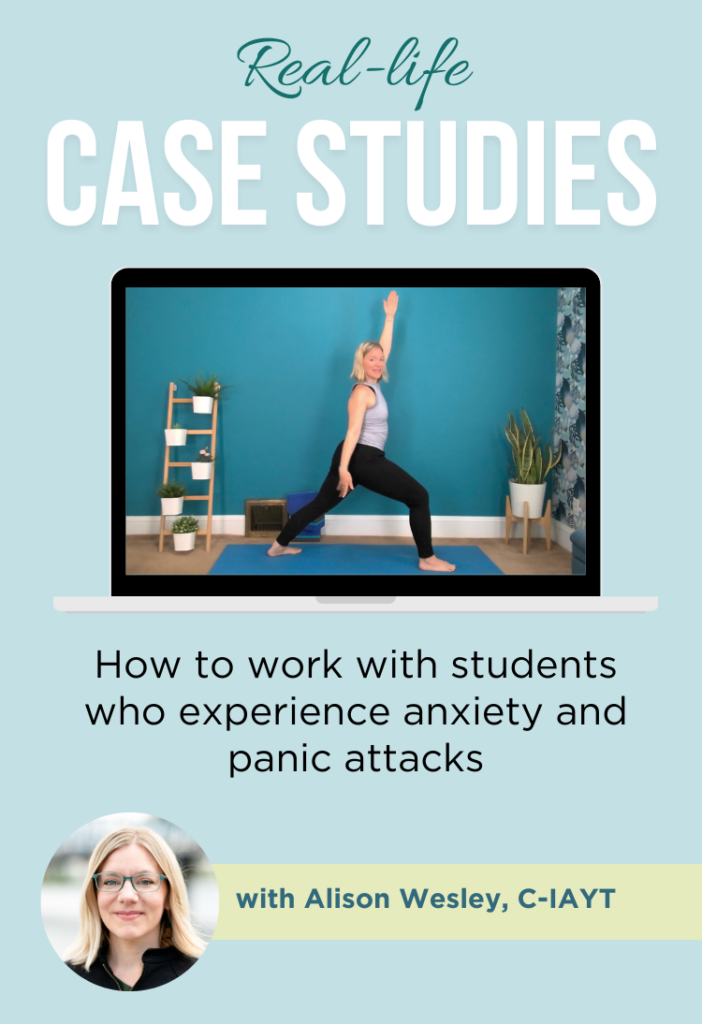
Part 1: What questions to ask about anxiety and panic attacks
Part 2: Using a story and movement to embody fierceness and strength
Part 3: Using flow and mantra to deal with anxiety and panic attacks
Part 4: Using restorative practice and yoga nidra to address anxiety and panic attacks
+ Virtual Event: A chat with Alison Wesley about collective and personal anxiety and how to support the students who experience it
About Alison
Alison Wesley is a Faculty Franklin Method Educator and Registered Yoga Teacher/Therapist in Portland, OR. She started Working with Yoga in 2008 (now Movement at Work) as a way to reach folks who might not be going to studios/gyms, making movement accessible where and when people work. She designed and leads mobility classes for back care at Rebound Physical Therapy and has a therapeutic movement video series called ThrUMovement. Along with geeking out about movement, anatomy, and mental training, Alison kickboxes with her father, plays music with her husband, spends hours trying to train her two German Shepherds, dances salsa, and will endlessly be studying Spanish.



Excellent artile and reminders. Don’t usually take time to read blog posts. So glad I did this morning. A reminder to keep it simple! Thank you.
Thanks so much, Jeanne!
Some great tips here, which I’ll use in my classes over the next week. Thanks Alison
Thanks so much, Nigel!
Nicely said Alison. It is always good to be reminded of ways to simplify our yoga classes in this fast paced, anxiety riddled, beautiful crazy world. Simplicity is key. I like your words success, simplicity and power are three things people experiencing anxiety can really use. Thank you.
Yes, Debby! Thank you for reading 🙂