Planning a yoga class for people experiencing cancer

“No one is wise by birth, for wisdom results from one’s own efforts.”
T. Krishnamacharya
This quotation from the great modern yoga master, Krishnamacharya, expresses what challenges like cancer can offer: the chance to learn about ourselves and to grow.
In this case, “one’s own efforts” refers to practice, setting aside time for intention. The yoga tradition calls it sadhana – a discipline performed regularly for the attainment of inner experience.[i] Certainly, in the face of a serious diagnosis, practice may not be easy. But, I learned during my own bout with cancer, that practice could provide stability, confidence, and a path to that inner experience.
by Julie Shaw, MEd, C-IAYT
In this case, “one’s own efforts” refers to practice, setting aside time for intention. The yoga tradition calls it sadhana – a discipline performed regularly for the attainment of inner experience.[i] Certainly, in the face of a serious diagnosis, practice may not be easy. But, I learned during my own bout with cancer, that practice could provide stability, confidence, and a path to that inner experience.
As yoga teachers, we have the opportunity to help those experiencing cancer engage in such practice. It does not need to be complicated; in fact, it should be simple. Simplicity makes the practice accessible for the range of experiences happening in the room and, perhaps more importantly, offers a clear path inward, where each person can connect to their own sources of inspiration.
Below is a template for designing such a class. Of course, you’ll use your own words and adjust the plan to your students’ circumstances, including length of the class (see Notes and Cautions at end of article).
1 . Select a Model
In this case, I’ll use the Pancamaya model of the five permeating sheaths of experience, below. The class will include components that affect each level. In many cases, one yoga tool will touch several levels, so the class design can remain as simple as possible. For example:
- heart/spirit – meditation
- intellect/personality – self-study, meditation
- mind/cognition/senses – attention, breath, movement, relaxation
- physiology – breath, movement, relaxation
- anatomy – breath, movement, relaxation
2. Select a Theme
Choose ideas that are broad so many people can relate. Avoid terms that could inadvertently cause discomfort. Consider using the same theme over several classes to give people a chance to revisit and grow with the fruits of their practice. Keep the words simple, even if they convey big ideas. Examples:
- Presence
- Light
- Wisdom
- Resilience
- Inner Awareness
3. Design the Class Sequence
Opening / Inner Focus
Yoga practice is like a journey—we travel from the external world to the internal and back again, hopefully changed for the better. Develop a simple opening that students can recognize at each class.
To begin the journey inward, we often focus on our senses, which take in information. It’s a way to gather our typically externally-focused attention and purposely direct it inwards. Here’s an example (with cancer patients, taste and smell may be sensitive, so I’ve omitted them). Pause to allow time between these steps:
- Sit as tall as you can with comfort.
- Take three smooth breaths in and out through your nose.
- As much as you can, bring your mind to an open, objective state.
- Mentally note the day and time.
- Tune in to the sounds you can hear.
- Tune in to the touch of clothing on your skin.
- Notice any sensations in your body.
- Notice the thoughts and emotions that happen to be in your mind.
- Bring your attention to your breath at the tip of your nose. Follow each breath in and out, smoothly.
- Consider the theme of Presence. Sense yourself to be in a calm, alert state of presence, here and now, ready to for your practice.
Movement
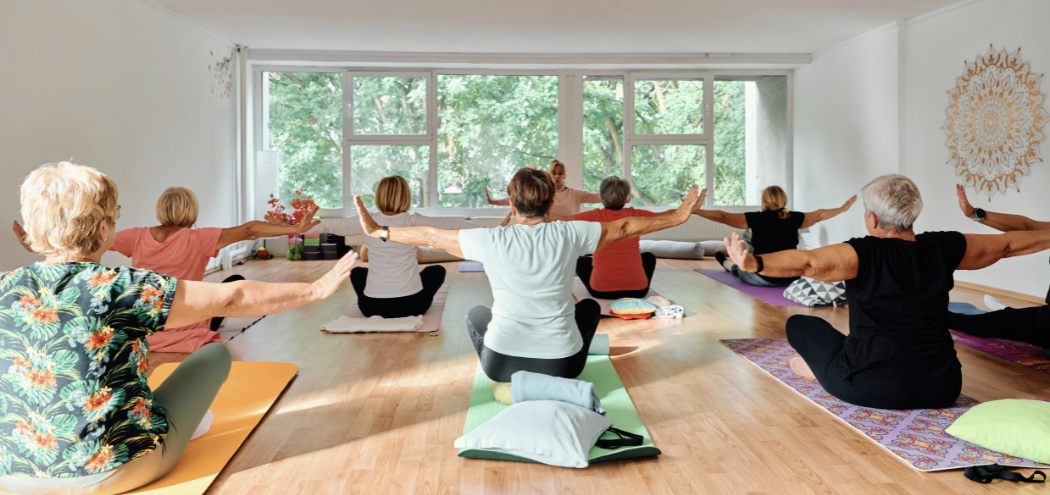
The asana portion may be shorter than in a general class. It’s easiest to instruct if everyone is either on a mat or in a chair, although that may not always be possible.
There are so many possible symptoms and side-effects with cancer that it’s essential to use simple, gentle postures accessible to a broad range of practitioners. Be thoughtful with spinal conditions, post-surgery limitations, fatigue, brain fog, blood pressure, neuropathy. Within limitations, use postures that gently expand the chest, lengthen the spine, move the head, neck, hands, and feet, and increase circulation. Always offer the option of breathing and just visualizing the movement.[ii] The keyword is simple.
In the Viniyoga tradition, we coordinate movements with inhalation and exhalation. By linking breath and movement, we create a tangible connection between the body and the mind which helps keep the practitioner in the present moment. This can be especially valuable for those experiencing illness, since the mind often wants to run toward worry or rumination. To help with this, you may ask students to pause after each posture and reconnect to the theme of the class.
- Reconnect to our theme of Presence. Feel yourself to be right here, right now. Feel your body in contact with the floor/chair. Feel your breath flowing in and out. Mentally say, “I’m doing my practice now.”
Offer a final relaxation pose, long enough to let the body unwind, but not too long to bring on deep sleep.
Breath Practice
Cancer treatments may affect breath capacity, so keep the pranayama simple. Here’s an example (pause between bullet points to give students time to experience each step):
- Feel your breath flowing in and out at the tip of the nostrils.
- Place one hand on your belly and one on your chest. Notice the body expands when you inhale and contracts when you exhale.
- Breathe smoothly and calmly.
- If possible, mentally count to 4 on the inhalation and 6 on the exhalation. Allow the natural pauses between breaths.
- You may find it’s a little easier if you gently “drag” the breath through the throat on the inhalation and exhalation. But it’s fine if that doesn’t work for you. The important thing is to allow your breath to be smooth and comfortable.
- If it’s comfortable, count to 6 on the inhalation and 8 on the exhalation.
- After a few rounds, let the breath return to its natural rhythm.
- Notice the quality of your breathing now. Notice your state of mind.
Meditation
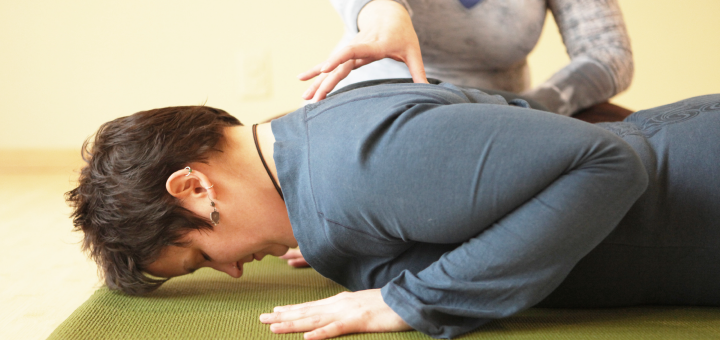
Everything to this point has prepared the students for meditation. Hopefully, the body feels relaxed, the breath is smooth and quiet, and the mind is clear. Offer a simple relaxation exercise to keep attention focused, followed by a self-reflection (speak slowly and pause between bullet points):
- Bring attention to your feet. Breathe in. Breathe out and relax. (Repeat with legs; hips; belly, chest, back, shoulders, facial muscles)
- Tune into the theme of Presence. To the best of your ability, remain aware of being right here and now, keeping an open, objective mindset.
- Tune in to the flow of your breath. Let your breath be completely natural. Rest your attention on it lightly, so as not to disturb it.
- Tune in to the physical effects of your practice. Perhaps you can sense sensations like “circulation,” “vibration,” “energy,” “release.” These are just my words; tune in to your own experience.
- Perhaps you can identify emotions are you experiencing. See if you can remain detached, naming the emotion as an observer, rather than entering into it as a participant.
- Perhaps you can feel a connection to your inner self, or to something that is hard to name, yet feels natural, inspiring, comforting. Whatever you feel is exactly right.
- Perhaps you are able to sense our theme of Presence, and that you are a whole being, that every aspect of you is inextricably inter-connected.
- And perhaps you can recognize that your inner Self is always present. That Presence is your abiding Nature?
- Continue to rest in that awareness.
Closing
When the energy in the room begins to stir, gently bring the group out of the meditation. Develop a simple closing that students can recognize at every class. This helps them transition from inner awareness back to the external world. Give them time to re-enter and to write in a journal, if they like. This is a wonderful way to capture realizations, perhaps helping people face difficult emotions. It also provides a chance to chronicle the joys and accomplishments along the road.
Most of all, convey to your students that whatever benefit they get from their practice, it is due to their own agency. Be their guide, but let them know that in practicing yoga, they are truly helping themselves.
Notes and cautions:
- Be sure you have the proper training in yoga or yoga therapy before teaching yoga to cancer patients and survivors.
- Match the techniques used to the students’ experience with yoga; many may have no yoga experience at all.
- Keep the components of the class simple and gentle so as to accommodate the varied symptoms participants may be experiencing.
- At the start of every class, check in with students’ conditions. Remind them that the practice is their own; it’s not a synchronized group event. Encourage them to modify with confidence and fully experience their sadhana.
Sequence Wiz readers gets a special $10 off discount on Julie’s new book, Hello, Nausea. How Are You Today? How Yoga Helped Me Through Cancer (regularly $35, with discount $25)
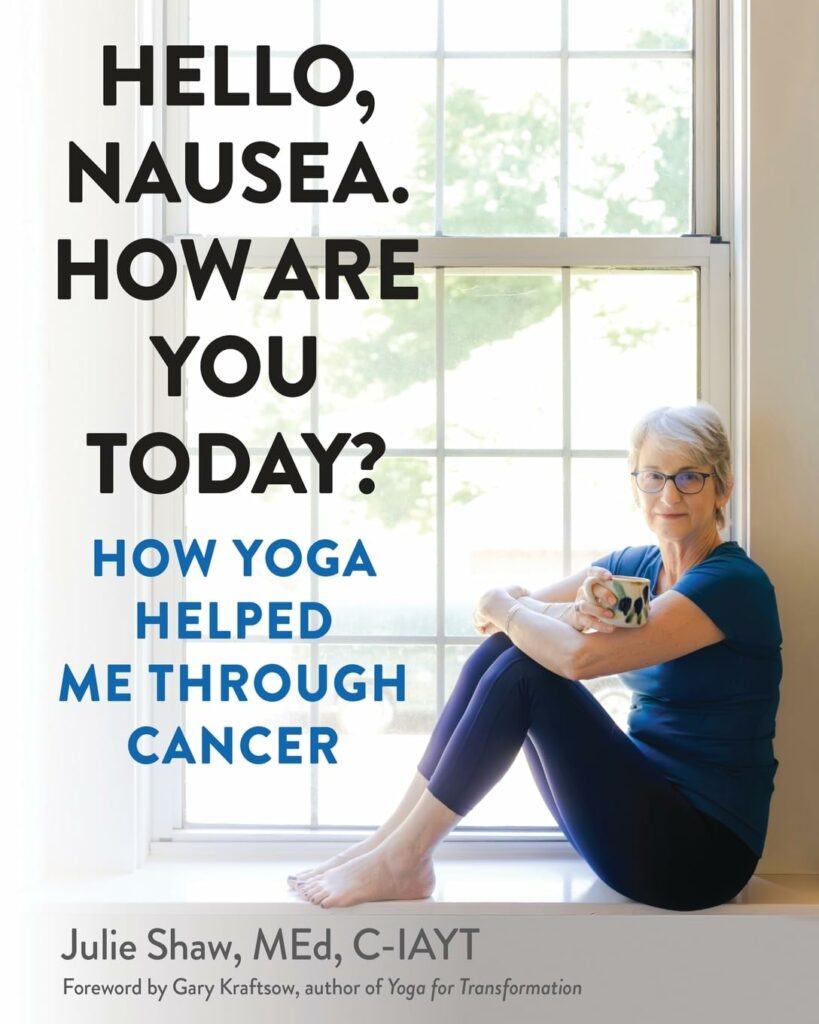
When certified yoga therapist Julie Shaw was diagnosed with breast cancer, she leaned into what she had relied on for more than three decades: her yoga practice. In her new book, Hello, Nausea. How Are You Today? How Yoga Helped Me Through Cancer, Julie shares a candid, compassionate, and often humorous account of her cancer journey, offering accessible yoga-based practices designed to support readers through treatment and recovery.
With over 35 years of yoga experience and certification as a Viniyoga Therapist, Julie brings both credibility and relatability to the page. She is a member of the International Association of Yoga Therapists and a lead faculty of the American Viniyoga Institute’s® accredited yoga therapy training program.
References
[i] Sanksrit Glossary of Yogic Terms, (2007), compiled by Swami Yogakanti, Yoga Publications Trust, Bihar, India, p. 150.
[ii] Doidge, Norman, MD., The Brain’s Way of Healing, (2016), Penguin Books, pp. 214-15.